
ECU Checksum Correction. Why Remapped Cars Still Fail
ECU Checksum Correction After Remap
ECU Checksum Correction. Why Does a Car Still Fail Even When the Maps Are Correct?
In ECU tuning and remapping, many technicians spend almost all of their time adjusting fuel maps, torque limiters, boost control, EGR, or DPF, while unintentionally overlooking a step that seems “automatic” – checksum correction. In real workshop situations, a wrong checksum alone can prevent an otherwise well-tuned file from being flashed, trigger ECU errors, put the vehicle into limp mode, or in severe cases, brick the ECU. In many cases, technicians repeatedly recheck the maps without finding any issues, while the real cause lies entirely in an incorrect checksum.
An ECU checksum can be simply understood as a validation value used by the ECU to verify whether the data stored in memory is still intact. The ECU does not “trust” modified data. Before accepting a file, it rechecks the relevant memory areas and compares them with the pre-calculated checksum value. If the data has been modified but the checksum has not been updated accordingly, the ECU will treat the file as invalid and refuse to operate. In other words, remapping without correcting the checksum is, by definition, still a faulty file.
Checksum calculation depends heavily on the specific ECU family. The most common method is summing the data values and applying a remainder operation, typically modulo 256. However, with newer ECUs such as EDC17, MD1, or MG1, checksum algorithms may involve CRC, XOR, or manufacturer-specific methods. For this reason, there is no universal checksum formula that applies to all ECUs. Each brand and ECU generation uses its own data validation strategy, which is why the checksum effectively becomes the “final gate” that determines whether the ECU will accept a tuning file or not.
In day-to-day workshop practice, many frustrating issues originate from checksum problems. Some files fail during the write process even though the maps are correct, some vehicles will not start after flashing, others show internal control module errors, or the car runs but develops unexplained minor faults. These situations often lead technicians to suspect the calibration itself, while the real issue is simply that the checksum is incorrect or has not been fully updated.
ECU Checksum Software and Tools:
In real working environments, checksum handling is almost always performed using dedicated software and programming tools. Some of the most commonly used solutions among ECU technicians include:
ECU File Editing Software
-
- WinOLS: the industry-standard tool for advanced file editing, allowing precise control over checksum areas and ECU calculation logic.
- ECM Titanium: a user-friendly solution suitable for beginners; however, with newer ECUs it is still recommended to verify the checksum after exporting the file.
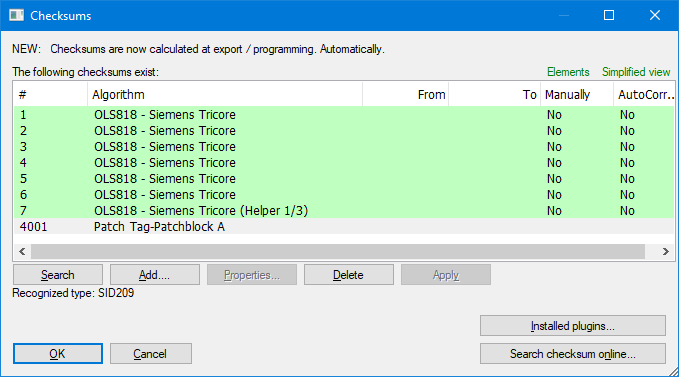
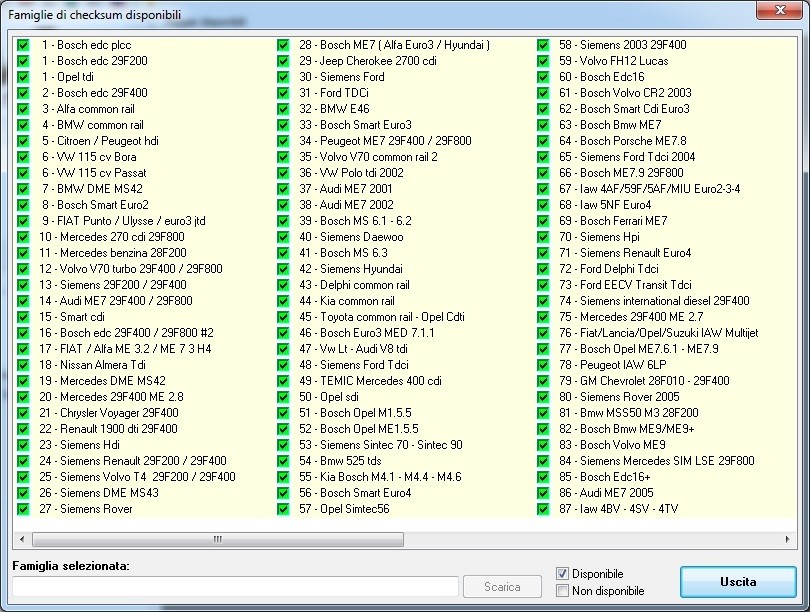
ECU Reading / Writing Tools
-
-
KESS3: supports automatic checksum correction during the write process and works via OBD, Bench, and Boot modes.
-
Dimsport (New Genius / Trasdata): features a strong checksum database and high stability, making it well suited for professional tuning workshops.
-
Flex: supports many modern ECUs and provides accurate checksum handling during flashing.
-
The general rule is that the editing software and the ECU programming tool must be compatible and correctly support the specific ECU type being worked on; otherwise, checksum errors may still occur even if the maps are properly calibrated.
Practical Example: Checksum After Modifying Spark Advance:
To make this clearer, let’s look at a simple example commonly used in ECU training materials. Assume you are tuning a gasoline ECU and modifying the Spark Advance table.
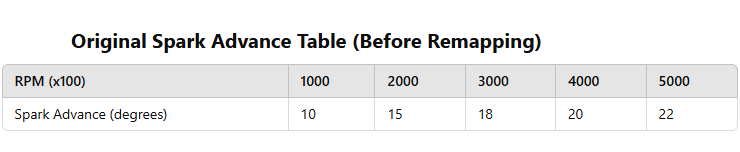
Before remapping, the ignition timing values are:
-
- Sum of spark advance values: 10 + 15 +18 + 20 + 22 = 85
- Checksum Calculation (modulo 256): 85 mod 256 = 85
- Checksum in Decimal: 85
- Checksum in Hexadecimal: 0x55
- Checksum in Binary: 01010101
After remapping, you increase the ignition timing:

-
- Sum of spark advance values: 12 + 17 + 20 + 23 + 25 = 97
- Checksum Calculation (modulo 256): 97 mod 256 = 97
- Checksum in Decimal: 97
- Checksum in Hexadecimal: 61
- Checksum in Binary: 01100001
The ECU will immediately detect a mismatch and reject the file. This illustrates the basic principle the ECU uses to protect itself.
Should You Correct the Checksum Manually?
From a theoretical standpoint, it is possible to correct a checksum manually if you can precisely identify the checksum area, fully understand the ECU algorithm, and know exactly which byte or word must be updated. In real workshop conditions, however, this approach is rarely practical due to the time involved and the high risk of error. Manual checksum correction is generally limited to learning purposes, reverse engineering, or ECU research. For everyday tuning work, using software and tools with built-in checksum support remains the safest and most efficient solution.
When Should You Use an ECU Checksum Correction Service?
When dealing with uncommon or rare ECUs, encountering write errors with unclear causes, or when you are not confident that the checksum has been handled correctly, using a professional checksum correction service is a sensible choice. The file will be checked and corrected according to the specific ECU, prepared for safe flashing, and the risk of bricking the ECU will be minimized, saving valuable troubleshooting time.
Conclusion
In ECU tuning, a well-designed calibration is only part of the equation. Equally important is ensuring that the ECU actually accepts the file and operates reliably over time. The checksum is the key factor that determines this. A proper tuning file is not only one that delivers improved performance, but also one with a correct checksum that has been validated by the ECU and proven safe in real-world operation.
——————————————————————————–
Contact Us
 Email: autoservicerun@gmail.com
 WhatsApp: +1(418) 478 2325
 Website: Autotunemaster.info