
What is ECU Cloning?
A Complete Technical Guide to ECU Cloning: Process, Benefits, Challenges & Real Case Study
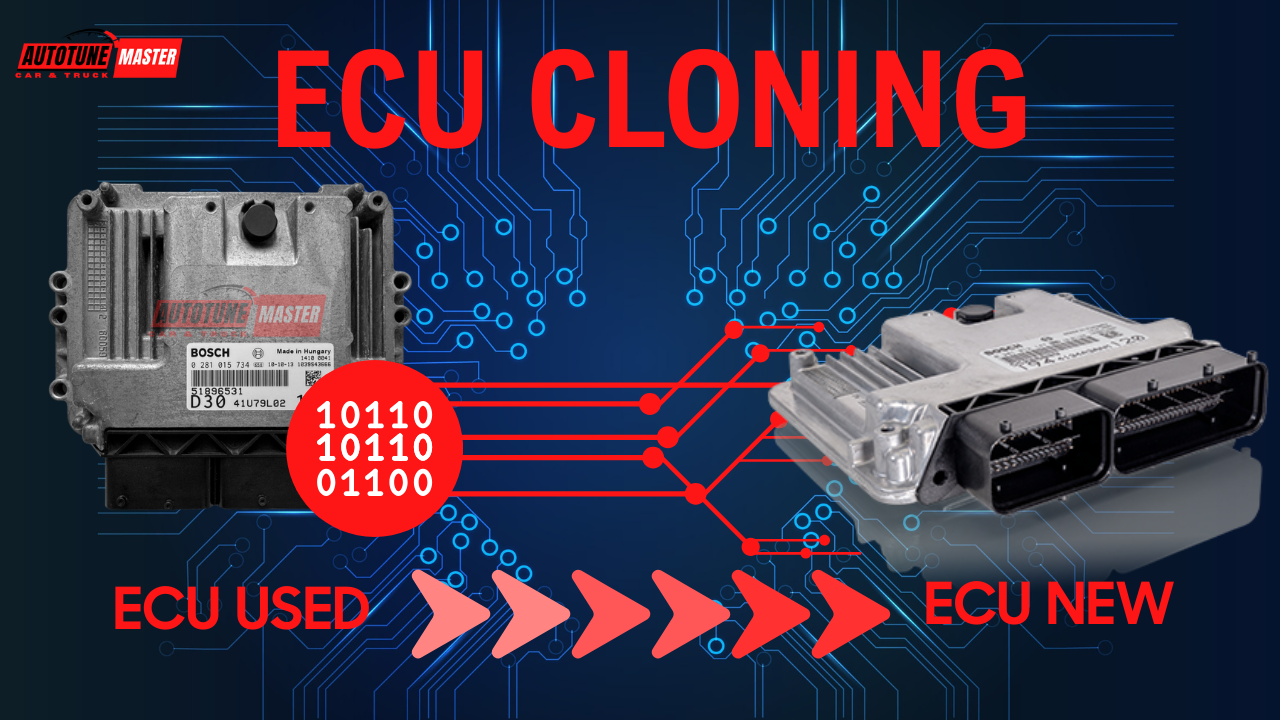
ECU Cloning is one of the most essential procedures in modern automotive electronics repair. When the Engine Control Unit becomes damaged due to water, short circuits, overheating, or internal component failure, replacing it with a brand-new ECU can be extremely costly. ECU cloning offers a highly reliable and cost-effective alternative by transferring all original data—including immobilizer, coding, and calibration—onto a replacement ECU so the vehicle can operate exactly as before. This guide provides a full technical overview of ECU cloning, including how it works, when to use it, the complete process, benefits, risks, and a real-world case study.
1. What Is an ECU and How Does It Work?
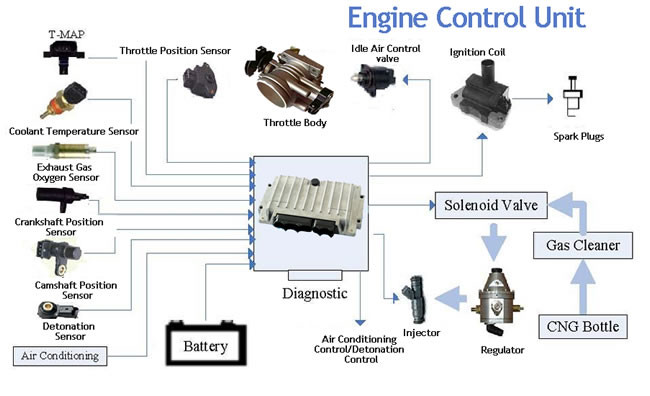
The Engine Control Unit (ECU) is the central computer that manages: Fuel injection, Ignition timing, Turbo boost control, EGR/DPF/SCR/NOx systems, Throttle control, Sensor interpretation, Diagnostic fault detection, Engine protection strategies
Modern ECUs communicate with dozens of sensors (MAP, MAF, O2, EGT, IAT, crankshaft, camshaft, etc.) to calculate optimal engine performance and emissions compliance. Because the ECU stores immobilizer (IMMO) and vehicle coding, it cannot be replaced without reprogramming—unless a complete clone is performed.
2. What Is ECU Cloning?
ECU Cloning is the process of duplicating every data segment from the original ECU and writing it into a replacement ECU. The result is a fully identical ECU that does not require immobilizer programming or re-coding. Typical data cloned includes:
-
-
-
Flash/Maps (calibration data)
-
EEPROM (IMMO, VIN, coding)
-
MCU Internal Flash
-
Hardware configuration files
-
Security data & OTP sectors
-
-
A cloned ECU will start and run the engine exactly like the factory original.
3. When Should You Clone an ECU?
ECU cloning is recommended in the following cases:
-
- Original ECU is damaged but still readable : Water damage, burnt components, short circuits, power supply faults, driver IC failures.
-
- Replacing with a used ECU of the same hardware type: Cloning allows plug-and-play operation without dealer programming.
-
- Avoiding online coding or immobilizer adaptation: Useful for workshops without OEM online accounts.
-
- Preserving custom tuning: Stage 1/2, DPF/EGR/SCR OFF, performance maps remain intact.
-
- Cost-effective solution: New ECUs can cost $500–$2000+, while cloning used ECUs is far cheaper.
4. The Complete ECU Cloning Process (Step-by-Step)
ECU cloning is performed using tools such as KESS3, PCMFlash, Autotuner, BitBox, Flex, KTAG, Dimsport, MMCFlash, etc.
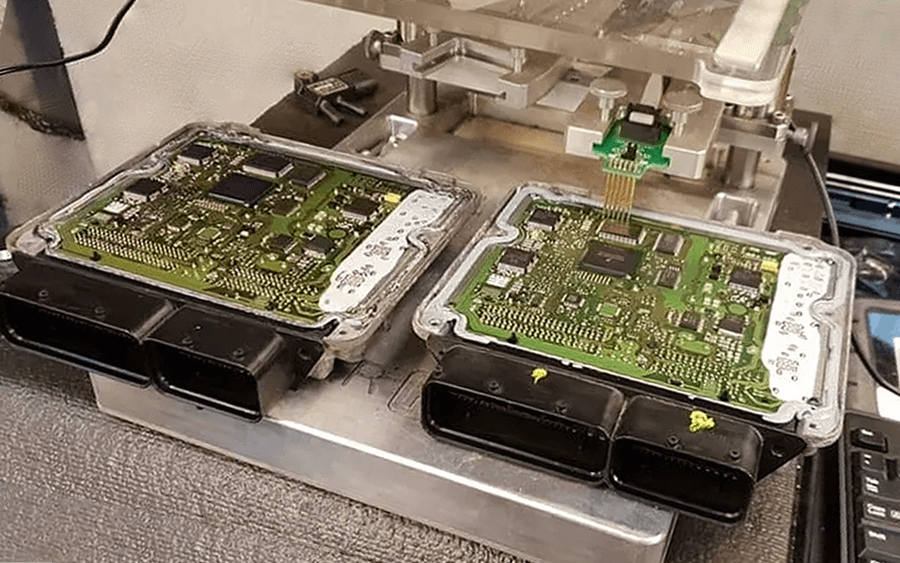
Step 1 – Read data from the original ECU
Connection methods: OBD, Bench mode, Boot mode / BDM / JTAG
Data extracted: Flash, EEPROM, Internal MCU data
Step 2 – Validate and back up data
The technician checks:
-
-
-
File integrity
-
Checksum
-
IMMO and VIN structures
-
Flash/EEPROM compatibility
-
-
Step 3 – Prepare the replacement ECU
This may include:
-
-
-
Erasing old data
-
Restoring “virgin” state
-
Cleaning immobilizer sections
-
Applying hardware configuration
-
-
Step 4 – Write original data to replacement ECU
All segments from the original ECU are transferred.
Step 5 – Vehicle testing
-
-
-
Communication check (OBD/CAN)
-
IMMOBILIZER validation
-
Engine start test
-
Full diagnostics scan
-
Road test
-
-
When the replacement ECU behaves identically to the original, the clone is considered successful.
5. Benefits of ECU Cloning
-
- Cost Savings Up to 70% cheaper than buying a brand-new OEM ECU.
- Plug-and-Play Operation No immobilizer pairing, no dealer visits, no online coding.
- Faster Vehicle Recovery Ideal for commercial vehicles where downtime = financial loss.
- Preserve tuning & custom calibrations All modifications remain exactly as previously configured.
- Reliable fix for hard-to-program vehicles Many ECUs are not easily programmable through OBD.
6. Challenges and Risks of ECU Cloning
-
- Security locks & encryption: Many ECUs are protected by: TPROT, GPT protection, OTP sectors, Rolling security codes
- Corrupted original data: If EEPROM or Flash is unreadable, cloning may fail.
- Hardware version mismatch: Different PCB revisions may be incompatible.
- Boot mode risks: Incorrect pinout or voltage can permanently damage the ECU.
- CAN communication issues after cloning: Seen on BMW MEVD, VAG EDC17, Mercedes CRD, etc.
7. Real Case Study – Renault Megane RS250 ECU Clone
A Renault Megane RS250 arrived with:
-
-
-
No start
-
No communication
-
Previous repair attempts failed
-
Immobilizer error
-
-
Solution:
-
-
-
ECU opened and read in boot mode
-
Flash + EEPROM extracted
-
Matching used ECU prepared
-
All original data cloned
-
Checksum corrected
-
Installed and tested
-
-
Result:
Vehicle started immediately and operated perfectly. Immobilizer and coding were fully retained.
Conclusion
ECU cloning is a highly effective and affordable method to restore damaged ECUs, especially when OEM replacements are expensive or unavailable. When performed correctly with professional tools, cloning delivers a 100% identical ECU without coding, immobilizer programming, or online access.
Contact Us
📧 Email: autoservicerun@gmail.com
📱 WhatsApp: +1(418) 478 2325
🌐 Website: Autotunemaster.info